For a first visit, choose Woljeongsa’s fir forest and temple courtyard, and return to the same starting point. The core forest path is about 1 km one way; Seonjae-gil continues toward another temple, Sangwonsa, on a roughly 9 km route. The short visit needs about two hours on site, while the longer walk needs several hours and a planned way back.
Both are in Odaesan National Park, in Pyeongchang, Gangwon Province. This guide is based on published sources, not a personal visit. Information was checked on November 5, 2026.
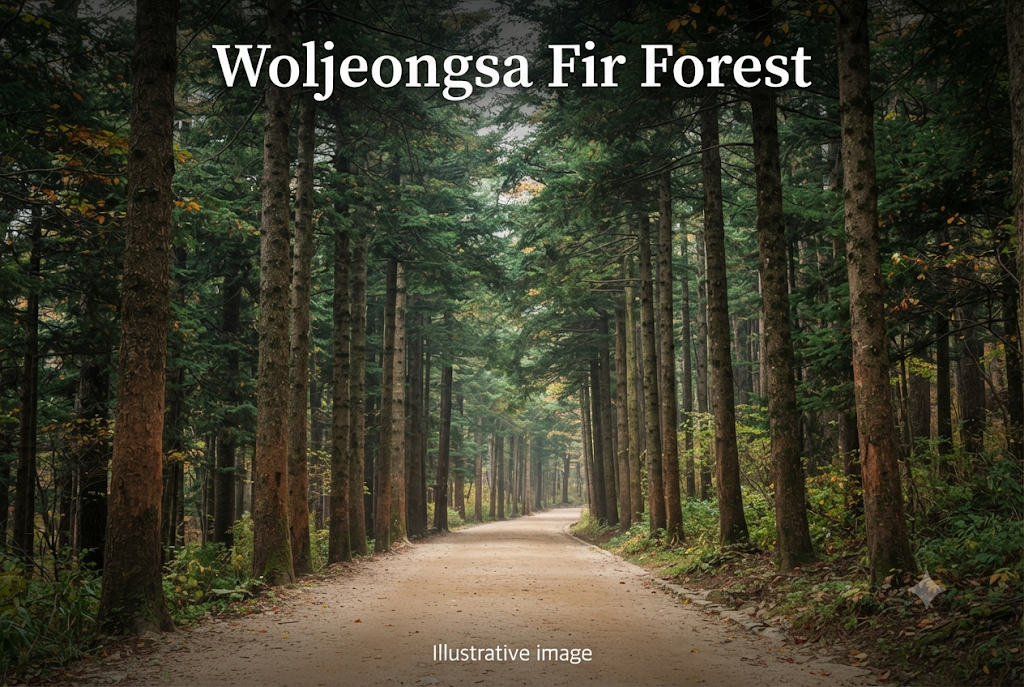
The two walks at a glance
| Fir forest and Woljeongsa | Seonjae-gil | |
|---|---|---|
| What it connects | Iljumun Gate and Geumganggyo Bridge, beside Woljeongsa | The Woljeongsa area and Sangwonsa, farther up the valley |
| Distance | About 1 km for the core forest section; retracing it means about 2 km, plus the temple visit and access walking | About 9 km one way; roughly 18 km if you retrace the route |
| Time to set aside | About 2 hours on site, excluding transport | At least 4–5 hours for walking and stops, excluding onward transport |
| Suitable choice | A first visit focused on the forest and temple | A longer walking day, with access and return transport confirmed |
Times are planning estimates. KNPS lists about 3 hours 30 minutes of walking for Seonjae-gil, before longer stops. Different starting points explain some variation in published distances.
Getting there: Jinbu Station is not Jinbu Bus Terminal
For travelers coming from Seoul, the clearest approach is a KTX train to Jinbu (Odaesan) Station (진부역) — Search on Naver Map, followed by a taxi to the Woljeongsa parking area. The temple’s transport guidance estimates about 20 minutes for that taxi journey; the fare has not been verified.
Show the driver “월정사 주차장” (Woljeongsa parking area), and arrange the return pickup, meeting point and fare basis before leaving the vehicle.
For the bus option, start at Jinbu Bus Terminal (진부시외버스터미널) — Search on Naver Map, a separate location from the railway station. County transport information lists route 225 for Woljeongsa and route 226 for Sangwonsa via Woljeongsa. The published adult rural-bus fare is KRW 1,000 per ride, by cash or transport card; this does not mean a foreign bank card can be tapped as a transport card.
Published 226 departures from Jinbu include 09:05, 10:00 and 11:05. These are terminal times. A return passing time at Woljeongsa is not given in that table, so the arranged taxi return is simpler for a first visit.
A short route with a clear finishing point
The temple address is 374-8 Odaesan-ro, Jinbu-myeon, Pyeongchang-gun. Woljeongsa (월정사) — Search on Naver Map. Map links here are searches for verified places, not confirmed place-detail pins or reservations.
- Find Geumganggyo Bridge (금강교). The temple’s published approach runs from the parking area across this bridge toward Woljeongsa. Use the local signs to locate the forest path toward Iljumun Gate.
- Walk the forest section toward Iljumun Gate (일주문). The gate is the opposite endpoint of the approximately 1 km core section. It is your turning point for this short route.
- Retrace the forest path to the bridge, then visit the temple courtyard. This keeps the walk’s endpoints clear and avoids accidentally continuing toward Sangwonsa.
- Return to your agreed pickup point. Allow around two hours for the forest and courtyard together; add time if your group walks slowly.
Visit in daylight. Allow roughly 60–90 minutes for the forest out-and-back and 30 minutes for the courtyard, excluding transport.
What the forest and temple mean
Jeonnamu is the Korean name for needle fir. Look up at the tall trunks and evergreen canopy, then notice how the forest leads toward the temple. The trees form an approach to an active religious place, not a separate garden with a compulsory circular route.
At Iljumun, look from the side: “one-pillar gate” refers to its single line of supporting pillars. In the courtyard, find the pagoda’s eight-sided form and stacked stories. This Goryeo-period monument is later than the temple’s founding in 643.
The present wooden buildings are not all from 643: Woljeongsa was devastated during the Korean War and rebuilt afterward. Its name 月精寺 contains the characters for moon, essence and temple, but the exact naming origin is debated.
This remains a place of worship. Keep the courtyard visit quiet, and follow the posted access and photography rules before entering a hall.
Seonjae-gil: a different day’s walk
Gil means “path.” Seonjae is Sudhana, a young seeker who learns from many teachers in the Buddhist Avatamsaka Sutra. The name connects walking with learning; it does not mean that the scriptural figure is documented as having visited this valley.
The route follows Odaecheon Stream toward Sangwonsa Temple (상원사) — Search on Naver Map. Monks and devotees used this connection before a road was built in the late 1960s. Today, visitors use it for both temple visits and recreational walking.
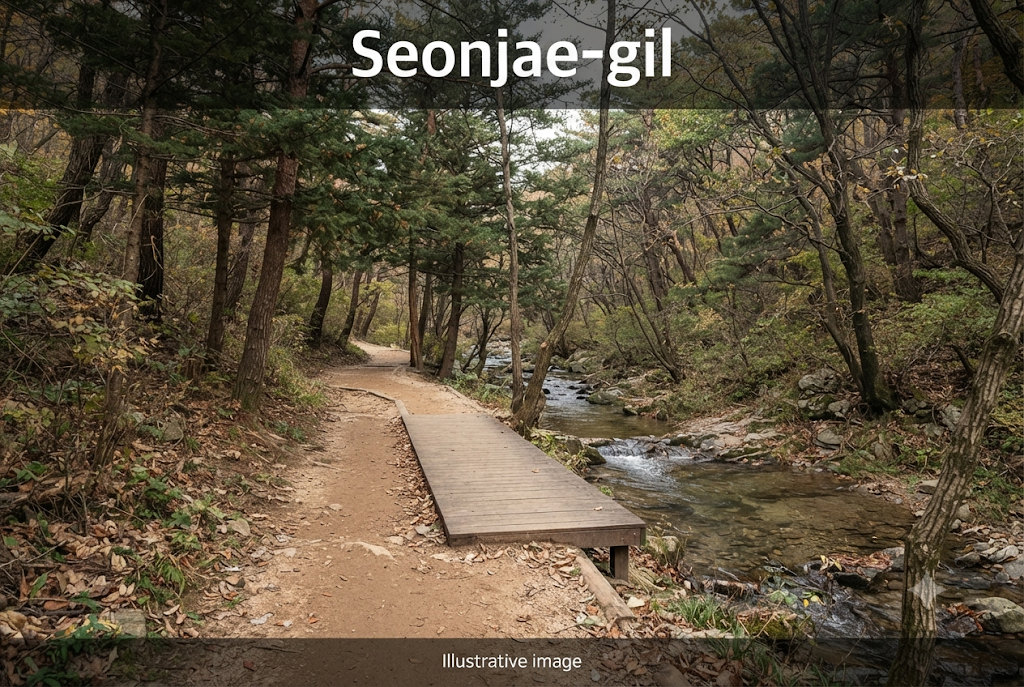
Expect earth, fallen leaves, steps and wooden decks rather than a continuous paved promenade. Interpretive signs about former settlements and forestry activity add a human history to the valley scenery.
For this first-visit plan, stop at Woljeongsa. The full Seonjae-gil walk is not an optional ten-minute extension, and Sangwonsa is not simply another building in the same courtyard.
November access and costs
On November 5, the KNPS overview displayed normal control status and listed a November 2 fire-prevention notice. The full current section list could not be verified. Although the standing guide allows Seonjae-gil during the usual autumn fire-prevention period, this November plan does not recommend the full through-walk.
Snow and ice can remain on shaded ground, and heavy rain can flood sections of Seonjae-gil. If the short forest approach itself is closed or icy beyond your equipment and ability, do not substitute an unsigned path. The park office is +82-33-332-6417.
Published local tourism guidance lists free admission to Woljeongsa and separate parking charges: KRW 3,000 for cars under 1,000 cc and electric cars, KRW 6,000 for the listed vehicle category of 1,000 cc or more, and KRW 9,000 for buses. Train tickets, taxis and meals are additional costs; no verified all-inclusive trip price is available.
Food: a practical plan and a local dish to recognize
Bring water and a light packed lunch for the short itinerary, so the visit does not depend on an unverified restaurant opening or price. Take packaging away and respect local eating restrictions.
If you choose a local meal, sanchae bibimbap (산채비빔밥) is rice with prepared mountain greens; sanchae jeongsik (산채정식) is a multi-dish set. Start with a little sauce so the greens’ flavors remain noticeable. A greens-based set is not automatically vegetarian: fish, meat or animal-based seasoning may also appear.
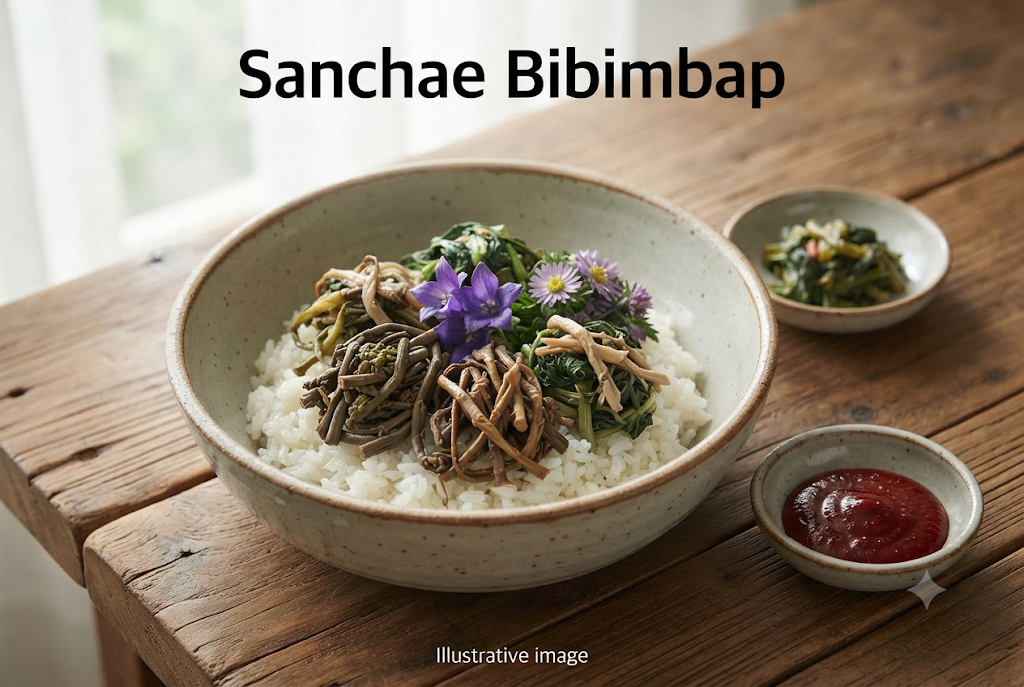
Before ordering a set, show: “1인분 가격인가요? 최소 몇 인분부터 주문하나요?” — “Is this the price per person? What is the minimum order?” Ask about separately charged dishes before adding a pancake or grilled item.
A named, price-confirmed restaurant stop is not included: nearby listings disagree on prices or hours. The packed-lunch plan avoids making the trip depend on those unresolved details.
An overnight stay is a separate choice
For an overnight cultural experience, the official Woljeongsa Templestay page lists rest-oriented programs by room occupancy. Choose your dates and party size, read the payment and cancellation rules, and retain confirmation. Availability and English support are unconfirmed.
This is an official, non-affiliate booking-information link. An overnight stay is not necessary for the short visit, and no reservation has been made.
The recommended first visit is simple: Jinbu Station, an arranged taxi transfer, the fir-forest out-and-back, Woljeongsa’s courtyard, and the same pickup point for the return. Save the full valley trail for a day planned specifically around walking and confirmed transport.
Sources
Checked November 5, 2026. Published information may change.
- Korea Tourism Organization: Woljeongsa and its fir forest — forest endpoints, address and heritage.
- Pyeongchang County: Jinbu bus timetable and rural-bus fares — routes, terminal departures and payment categories.
- Woljeongsa Templestay: transport guidance — Jinbu Station, terminal and taxi connections.
- Odaesan pilgrimage route: directions — parking-area, bridge and temple approach.
- KNPS: Seonjae-gil course and Odaesan notices — route, surfaces and access limitations.
- Pyeongchang tourism: Woljeongsa — admission and parking.
- Academy of Korean Studies: Iljumun; Sudhana; Youm Jung-seop’s study of Woljeongsa’s name.
- Korea Policy Briefing: Woljeongsa’s history; KTO material on mountain-greens cuisine.
The images in this article were created using generative AI for illustrative purposes.