Tongdosa’s main hall has no Buddha statue because the focus of worship lies just behind it: Geumgang Gyedan, a stone ordination platform that enshrines relics revered as those of the historical Buddha. The hall and the platform belong to one sacred arrangement. Understanding that connection changes what you look for when you visit.
At this mountain temple in Yangsan, near Busan, the most revealing detail is something you might initially think is missing.

The Buddha Is Represented by Relics, Rather Than a Statue
In many Korean Buddhist halls, a Buddha image gives visitors an obvious place to direct their attention. Tongdosa’s Daeungjeon (대웅전), its main worship hall, asks you to understand the space differently.
Behind the building stands Geumgang Gyedan (금강계단). Buddhist tradition connects its sacred relics with Jajang, the monk associated with Tongdosa’s foundation in the seventh century. Relics are physical remains or sacred objects preserved for veneration. Here, they are honored as the presence of Shakyamuni, the historical Buddha.
That explains the absence of a statue inside this particular hall. It does not mean that Tongdosa has no Buddhist images elsewhere. The distinction matters in a monastery with many buildings and different places of worship.
Tongdosa is also known as the Buddha Jewel temple among Korea’s Three Jewel Temples. The other two, Haeinsa and Songgwangsa, are associated with the Buddha’s teachings and the monastic community, respectively. At Tongdosa, the relics explain the special emphasis on the Buddha himself.
Two Names That Make the Space Easier to Read
Daeungjeon is commonly translated as “Hall of the Great Hero.” The “hero” refers to the Buddha. The name identifies a place of Buddhist worship even when the familiar statue is absent.
Geumgang Gyedan is commonly translated as “Diamond Ordination Platform.” “Diamond” evokes the firmness of Buddhist commitment. An ordination platform is a sacred setting associated with receiving the precepts: the rules and commitments of Buddhist life.
There is a small language trap here. In this name, gyedan means an ordination platform, not simply a staircase. Looking for a flight of steps would miss the point of the site.
The platform therefore carries two connected meanings: it enshrines revered relics and belongs to Tongdosa’s continuing tradition of monastic discipline. This is a living religious space, rather than an architectural exhibit alone.
Three Details to Notice on Your Visit
Start with the relationship between the hall and the space behind it. From areas open to visitors, identify Daeungjeon and locate the platform behind the building. Read them together. A view of the hall alone leaves out the reason for its unusual arrangement.
Look for the bell-shaped stone reliquary. The platform includes a raised stone structure with a bell-shaped reliquary at its center. A reliquary is a container or monument for sacred relics. Visitors should not expect to see the relics themselves on open display.

Notice the different name boards around the hall. The building has names associated with its different sides, including Daeungjeon, Geumgang Gyedan and Jeongmyeolbogung. The last identifies a sanctuary associated with the Buddha’s relics. These signs are useful clues to the building’s overlapping roles.
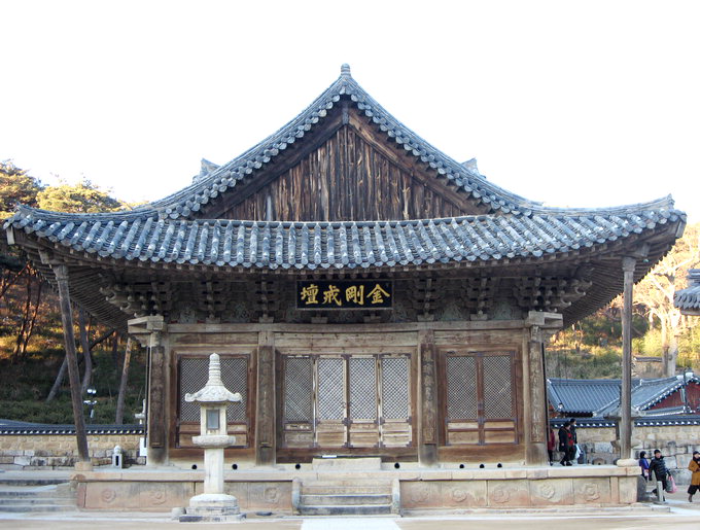
The monastery’s beginnings and the age of the hall are different stories. The present Daeungjeon was rebuilt in 1645 after destruction during the Japanese invasions of the late sixteenth century. Its wooden architecture and the older religious tradition should not be assigned a single date.
In 2018, Tongdosa became part of the UNESCO World Heritage property “Sansa, Buddhist Mountain Monasteries in Korea.” The recognition includes the continuity of religious life, as well as the buildings and their mountain settings.
Visiting the Temple and Entering the Platform Are Different
Do not assume that a visit to Tongdosa includes entry to Geumgang Gyedan. The temple’s published standing notice lists access on lunar-calendar days 1–3, 15, 18 and 24, from 11:00 a.m. to 2:00 p.m. It also states that the platform does not open in rain or when the ground is wet.
These are lunar dates, not the same numbered dates on an ordinary calendar. The notice was originally posted in 2017 and remains listed on the temple’s notice board; it is not a guarantee of access on your travel date. Special notices and instructions at the site take precedence.
Read the temple’s platform-access notice (Korean) and its current notices before planning around a platform visit. If the enclosure is closed, the hall’s relationship with the relic site remains the key to understanding this part of the temple.
For navigation, use Search Google Maps for Tongdosa Temple. The temple’s address is 108 Tongdosa-ro, Habuk-myeon, Yangsan, Gyeongsangnam-do.
Within worship areas, follow posted entry and photography rules and leave room for people praying. You do not need to take part in a ritual to appreciate the arrangement: the main hall makes sense when you understand what it faces.
No AI-generated images are included in this article.