Seonunsa’s main hall brings together naturally curved timber pillars and a central Buddha who may surprise visitors: Vairocana, rather than the historical Buddha, Shakyamuni. The pillars preserve the shapes of the trees used to build the hall, while the altar shows why a hall’s name alone cannot identify the Buddha inside.
A historic temple, a later wooden hall
Seonunsa Temple (선운사) — Search on Naver Map stands in Gochang, Jeonbuk. Its name connects meditation with clouds: an image of seeking understanding through Buddhist practice.
The temple is traditionally said to have been founded by the monk Geomdan in 577. That is a foundation tradition, not the construction date of the hall standing today. Following destruction during the Japanese invasions in 1597, the main hall was rebuilt in the 1610s and repaired repeatedly afterward. Heritage sources give 1613 or 1614 for its reconstruction; both place the surviving hall in the Joseon period.
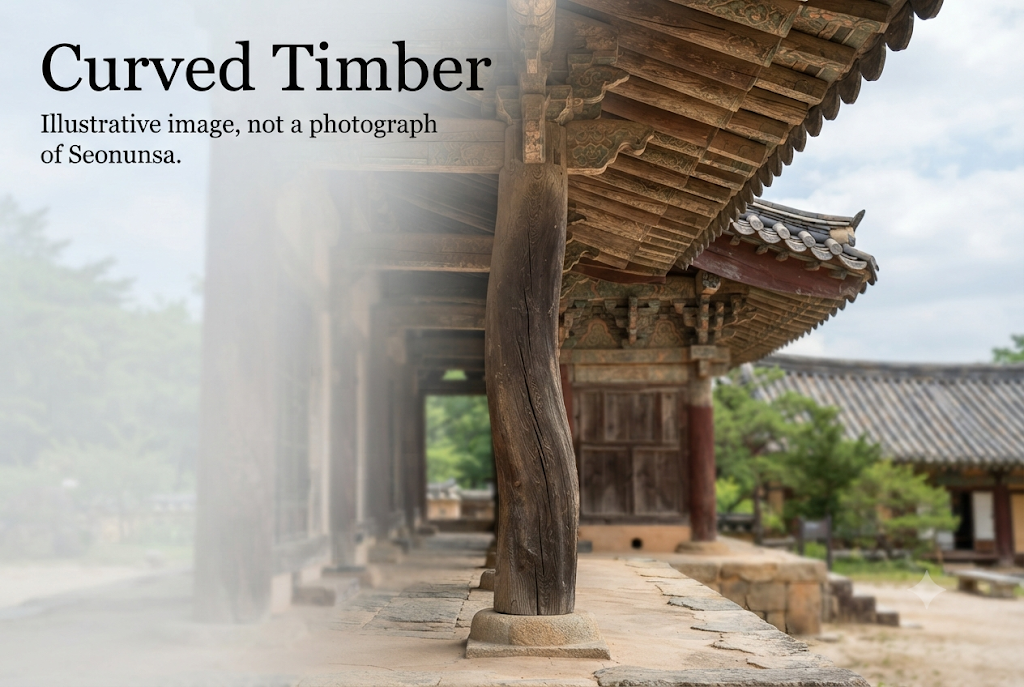
The curves belong to the timber
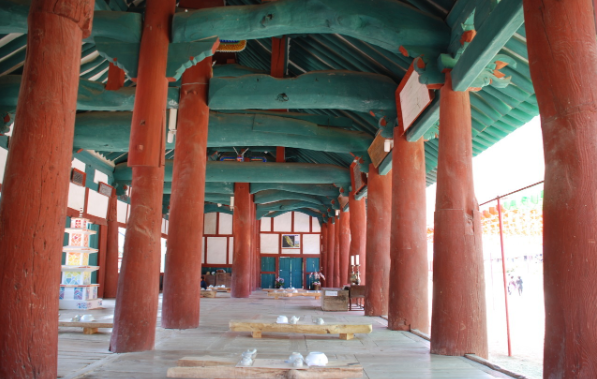
At Daeungjeon Hall (대웅전) — Search on Naver Map, some pillars retain the curves of their tree trunks. The heritage description identifies these as curved timbers used in construction. Their shape alone should not be treated as evidence that the building has started to lean.
From a permitted viewpoint, follow a pillar upward toward the roof. Then compare its irregular outline with the repeating brackets beneath the eaves. These clusters of fitted wooden pieces appear above the pillars and between them, forming the structure known as dapo, or a multiple-bracket system.
The broad frontage has five structural bays and the sides have three. A bay is the space between supports, not a separate room. Counting those intervals makes the hall’s proportions easier to understand without architectural vocabulary.
Vairocana at the center
A Daeungjeon commonly houses Shakyamuni, the historical Buddha associated with the beginning of Buddhism. Here, the central figure is Vairocana, understood in Buddhist teaching as the Buddha embodying universal truth. The two accompanying Buddhas are Bhaisajyaguru, associated with healing, and Amitabha, associated with the Western Pure Land.
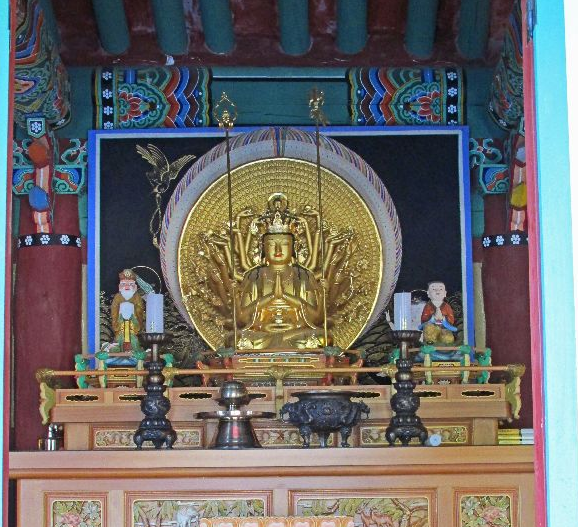
The site’s heritage interpretation connects this arrangement with a Buddhist understanding of Vairocana and Shakyamuni as ultimately one. This is a religious interpretation of the grouping, rather than a claim that every Korean main hall follows the same arrangement.
The three seated figures are clay sculptures dated to 1633. Inscriptions beneath their pedestals record their identities and production history, giving firmer evidence than appearance alone. Their broad shoulders and wide seated poses also help explain their imposing presence.
A focused visit and a local meal
For this visit, keep the main hall as your destination rather than adding a mountain hike. The Korea Tourism Organization lists temple visiting hours as 06:00–19:00, year-round, and Gochang’s admission table lists Seonunsa as free. These are temple-wide details; current access to the hall’s interior and permission to photograph inside were not independently confirmed. An interior-focused visit recommendation is therefore on hold. Temple enquiries: +82-63-561-1422.
Gochang’s local food specialties include grilled eel, often advertised as pungcheon jangeo. Yeongi Sikdang (연기식당) — Search on Naver Map, at 2727 Seonun-daero, Asan-myeon, is listed by Gochang tourism and lies on the approach to Seonunsa, near the entrance junction rather than inside the temple.
The provincial food portal lists ordinary eel at KRW 36,000 and eel soup at KRW 11,000, checked on November 4, 2026. It distinguishes ordinary eel from pungcheon eel, but does not specify the grilled portion’s weight, minimum order, or a current pungcheon-eel price. These figures are published reference prices, not a confirmed meal total. A fixed-price restaurant recommendation is on hold pending those details.
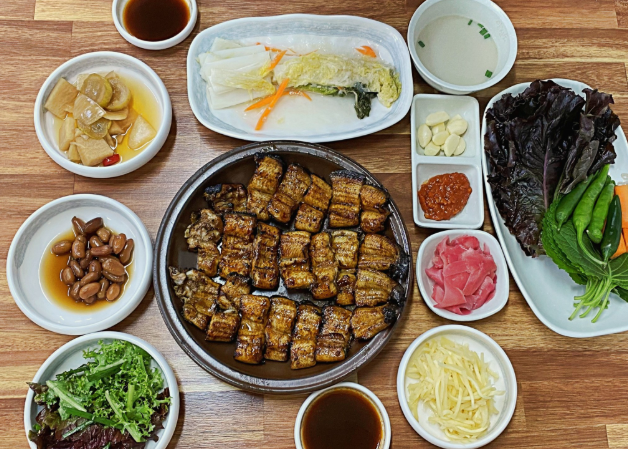
Before ordering, a useful sentence is: “이 가격은 몇 그램 기준이고, 최소 주문량과 밥값은 어떻게 되나요?” — “What weight does this price cover, what is the minimum order, and is rice charged separately?” The listing gives 09:00–21:00, but current last orders, reservation and payment conditions remain unconfirmed. Restaurant enquiries: +82-63-561-3815.
For an overnight temple experience, the official Seonunsa Templestay programme page is a separate programme and booking route, not a map or an admission ticket. Programme fees, language support, room arrangements and cancellation terms depend on the selected programme; availability and a booking have not been confirmed here.
The images in this article were created using generative AI for illustrative purposes.